
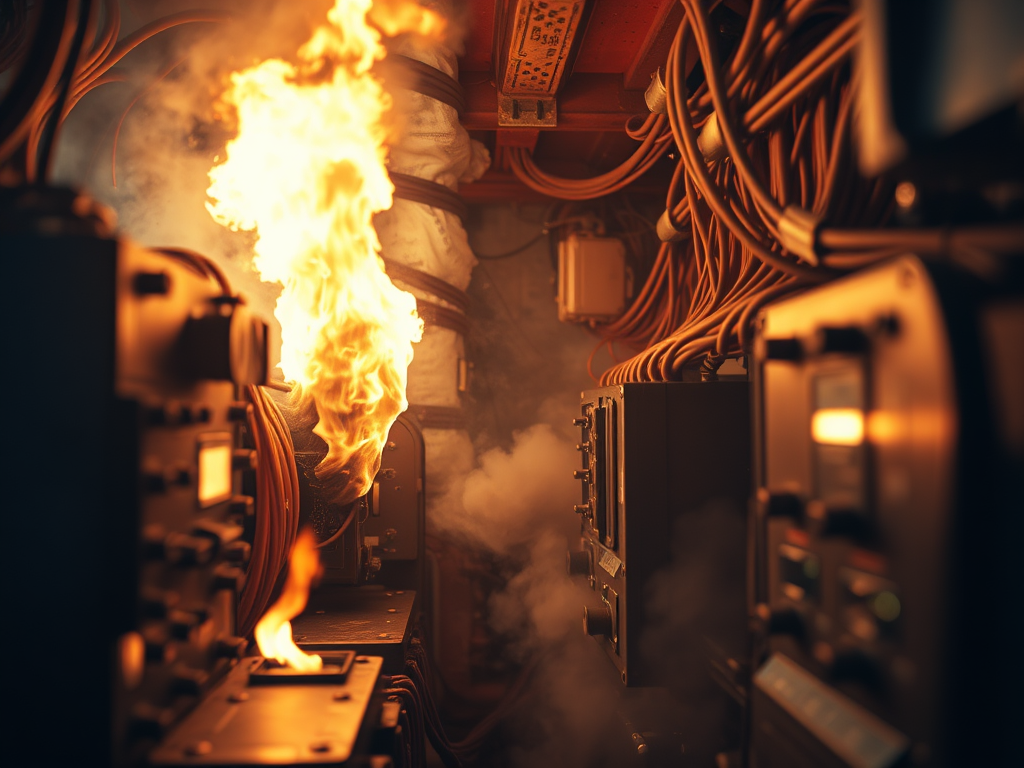
Thermal Runaway at Sea: Investigating the Genius Star XI Incident
A report by the National Transportation Safety Board (NTSB) regarding the lithium-ion battery fires aboard the cargo vessel Genius Star XI provides a stark warning about the complexities of transporting high-energy cargo across treacherous oceans. In late December 2023, two separate fires erupted in the ship’s cargo holds, resulting in $3.8 million in damages and a complex international salvage operation in Dutch Harbor, Alaska.
This synopsis breaks down the events, the technical failures that led to the blaze, and the critical safety lessons for the maritime industry.
The Incident: Fire in the North Pacific
The Genius Star XI, a 410-foot bulk carrier, was transiting from Vietnam to California with 192 Lithium-ion Battery Energy Storage System (BESS) units. On Christmas Day 2023, while battling 19-foot seas and gale-force winds, the crew discovered black smoke billowing from cargo hold no. 1. The crew successfully deployed the vessel’s fixed CO2 fire extinguishing system, seemingly suppressing the fire.
However, the ordeal was far from over. On December 28, a second fire ignited in cargo hold no. 2. With the ship’s CO2 supply already exhausted from the first incident, the crew had to rely on external boundary cooling with fire hoses to prevent the fire from spreading until they reached the safety of Dutch Harbor.
Probable Cause: A Chain of Mechanical Failures
The NTSB investigation revealed that the fires were not spontaneous but were the result of a catastrophic failure of the cargo-securing systems during heavy weather.
1. Incompatible Lashing Equipment The primary catalyst was the failure of the lashing belts used to secure the 21,000-pound BESS units. Investigators found that the hooks on the lashing belts were incompatible with the D-rings welded to the deck. The D-rings were too thick for the hooks to seat properly, meaning only the tips of the hooks were engaged. Under the extreme dynamic loads of the 22-foot seas, these hooks fractured and separated.
2. Internal Structural Collapse Once the lashing failed, the BESS units began to shift and slam into one another. This movement caused “shelf rail deformation” inside the units. The internal racks holding the heavy battery packs collapsed, causing the packs to fall and crash into each other.
3. Thermal Runaway and Arcing The physical damage to the battery packs led to electrical arcing and “thermal runaway”—a phenomenon where a lithium-ion cell enters an uncontrollable, self-heating state. The NTSB concluded that the fires originated from within three BESS units that had broken loose and suffered these internal structural failures.
Key Lessons
For Maritime Operators and Crews:
- Verify Equipment Compatibility: It is not enough to have rated lashing gear; the components must be physically compatible. The “tip-loading” of hooks on the Genius Star XI significantly reduced their effective breaking strength.
- Route Planning for High-Value/Hazardous Cargo: Following the accident, the charterer modified future shipments to take a more southerly route to avoid the extreme winter weather of the North Pacific.
- CO2 Reserves: The vessel was left defenseless for the second fire because the CO2 system was only designed for a single discharge. Operators should consider the risks of “re-flash” or secondary fires when carrying lithium-ion batteries, which are notoriously difficult to extinguish.
For Manufacturers and Shippers:
- Internal Securing is Critical: While the BESS units were secured to the ship, the internal components (the battery shelves) were unable to withstand the vibrations and shocks incident to transport.
- IMDG Code Compliance: Each BESS unit was classified under UN3536, which requires batteries to be “securely attached to the interior structure” to prevent significant movement. The shelf collapses on the Genius Star XI suggest that land-side energy storage designs may need reinforcement for the rigors of ocean transit.
Conclusion
The Genius Star XI incident serves as a textbook example of how minor equipment incompatibilities can lead to multi-million dollar disasters. As the world moves toward green energy, the maritime industry must evolve its safety standards to match the unique risks posed by large-scale lithium-ion battery transport. Rigorous inspections, compatible securing gear, and weather-conscious routing are no longer just “best practices”—they are essential for survival at sea.
Additional Reading
NTSB – Genius Star XI – Lithium Ion Battery Fire – December 2023
UK P&I – TT Club – Brookes Bell – Lithium Batteries – White Paper – November 2022